
Northern and Southern Vietnamese share the same written language and a large common vocabulary. Their pronunciation, tones, rhythm, and everyday word choices can still surprise a beginner. A learner may recognize the spelling on a menu and miss the word when someone says it quickly.
The best accent to learn is the one connected to the people you want to understand. If your partner, family, friends, teacher, or future home is in the South, begin with Southern Vietnamese. If your daily life is centered in Hà Nội or the North, begin with Northern Vietnamese. Then expose your ear to both regional voices.
Try VietBuddy, the best app to learn Vietnamese in the accent that fits your life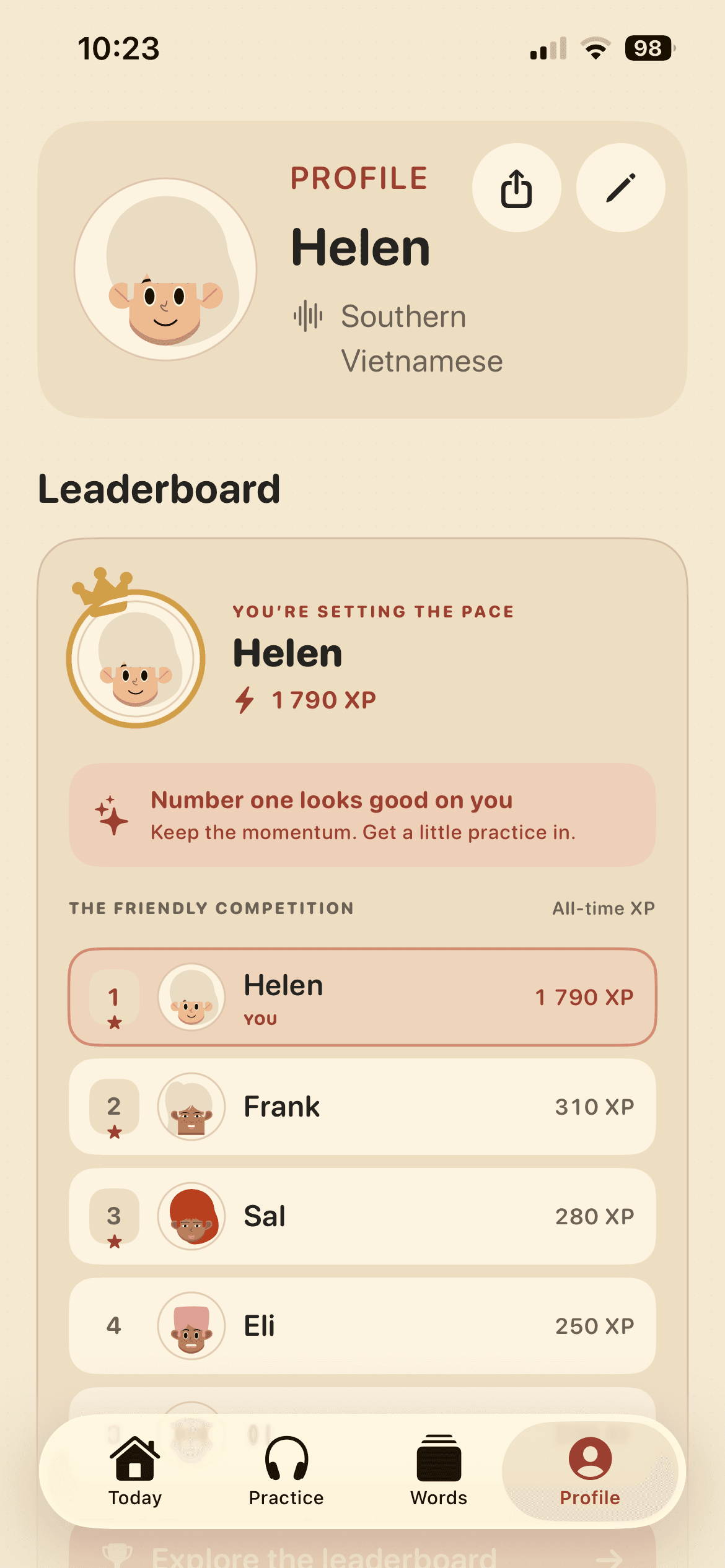
Northern and Southern Vietnamese at a glance
Accent labels describe broad patterns, not one fixed sound used by every person. Speakers from different cities and families can sound distinct. The table below gives you a starting map for listening.
| Feature | Northern Vietnamese | Southern Vietnamese |
|---|---|---|
| Common reference | Hà Nội and northern cities | Sài Gòn and southern cities |
| Tone system | Often keeps six tone contrasts | Hỏi and ngã often merge in speech |
| Initial sounds | d and gi often begin with a z-like sound | d and gi often move toward a y-like sound |
| Everyday vocabulary | Some words differ from Southern usage | Some words differ from Northern usage |
Listen for tone movement first
Tones are one of the clearest differences you will hear. Northern Vietnamese commonly keeps six contrasting tones. Southern Vietnamese commonly merges hỏi and ngã in everyday pronunciation, although individual speakers and contexts vary.
The useful habit is to follow the movement of the whole syllable. Notice whether the voice stays level, rises, falls, dips, breaks, or closes tightly. A natural voice also carries rhythm around the tone, which is why a tone chart becomes more useful after you hear it inside a sentence.
For a deeper explanation, continue with our practical guide to Vietnamese tones. You will find a short routine for hearing the tone before reading the transcript.
Notice the consonants and the rhythm
Many learners notice the d and gi difference early. In many Northern voices, they have a z-like beginning. In many Southern voices, they move closer to a y-like beginning. The letter r also changes across speakers and regions. These are useful patterns, while real speech remains more varied than a single rule.
Endings can shift too. Some Southern varieties bring final n and ng closer together, and other consonant contrasts may soften. Listen for the whole word and the sentence around it. Context, tone, and rhythm help the listener recover the meaning.
Vocabulary changes with the region
A few everyday words can point toward the North or the South. For example, a learner may hear ngô in Northern usage and bắp in Southern usage for corn. Pineapple can be dứa in the North and thơm in the South. These differences are worth learning when they appear in your own conversations.
Learn the word together with a sentence and a voice. That keeps regional vocabulary attached to a situation, such as ordering food, talking with relatives, or asking a neighbor for help.
Natural voices. Real-life Vietnamese.
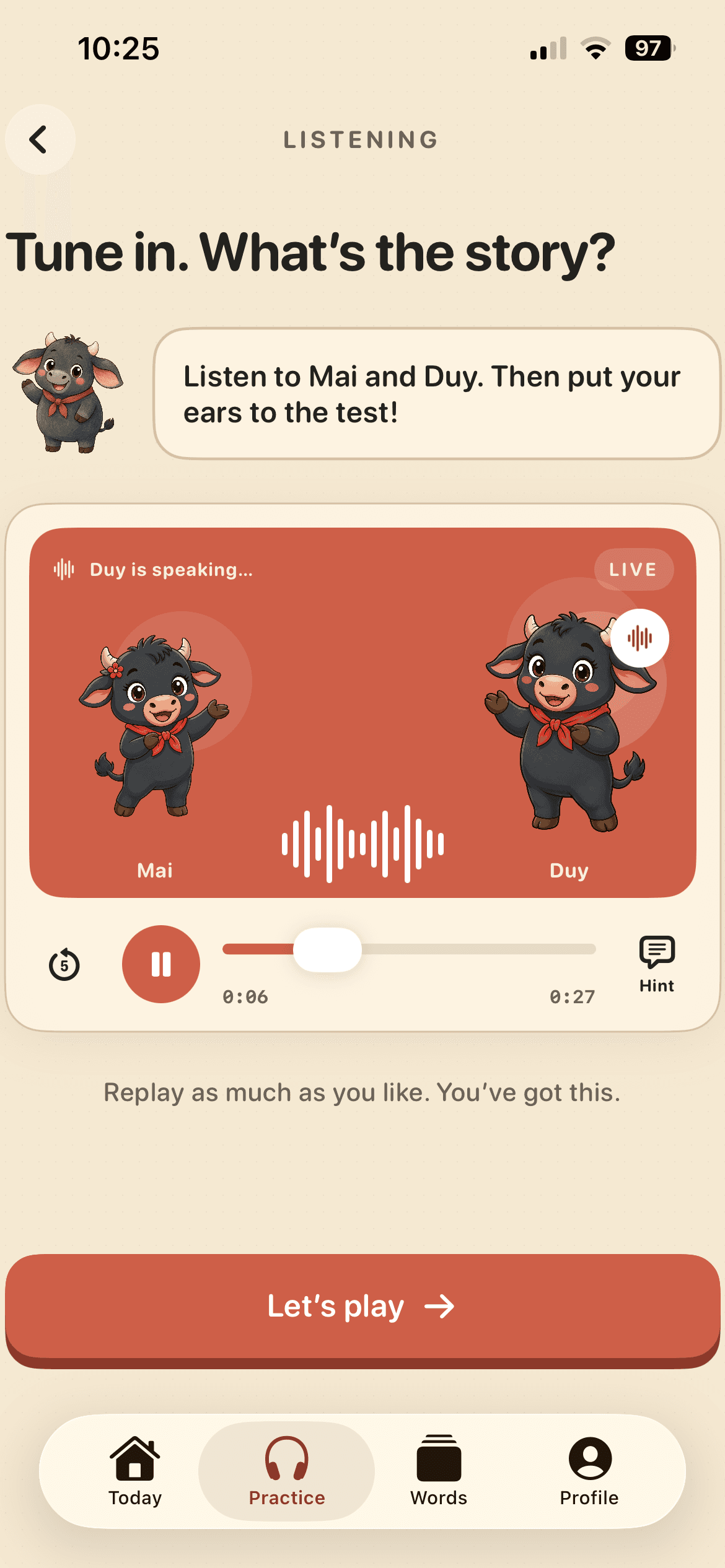
VietBuddy lets you choose Northern or Southern Vietnamese and practice with natural voices in realistic context. You hear situations that resemble daily life, from a café exchange to a quick conversation with a neighbor. You listen first, understand what is happening, then say useful spoken Vietnamese back.
Which Vietnamese accent should you learn?
Choose based on proximity and purpose. Southern Vietnamese can be the natural starting point for life in Hồ Chí Minh City, the Mekong Delta, or a Southern Vietnamese family. Northern Vietnamese can be the natural starting point for life in Hà Nội and the North. If you plan to travel across the country, choose one main accent and build recognition for the other.
You do not need to wait until one accent feels perfect. Start speaking with the people you care about, collect phrases from your real routines, and let repeated listening make the regional differences feel familiar.
A seven-minute accent practice routine
- Pick a phrase connected to your day.
- Listen once without reading anything.
- Identify the situation and the speaker's intention.
- Listen again for one tone or consonant pattern.
- Repeat the phrase in the same rhythm.
- Listen to the other accent when the phrase feels familiar.
Small contrasts become easier when they return inside different sentences. A daily listening habit helps you recognize an accent even when the speaker is fast, casual, or using words you have not studied yet.

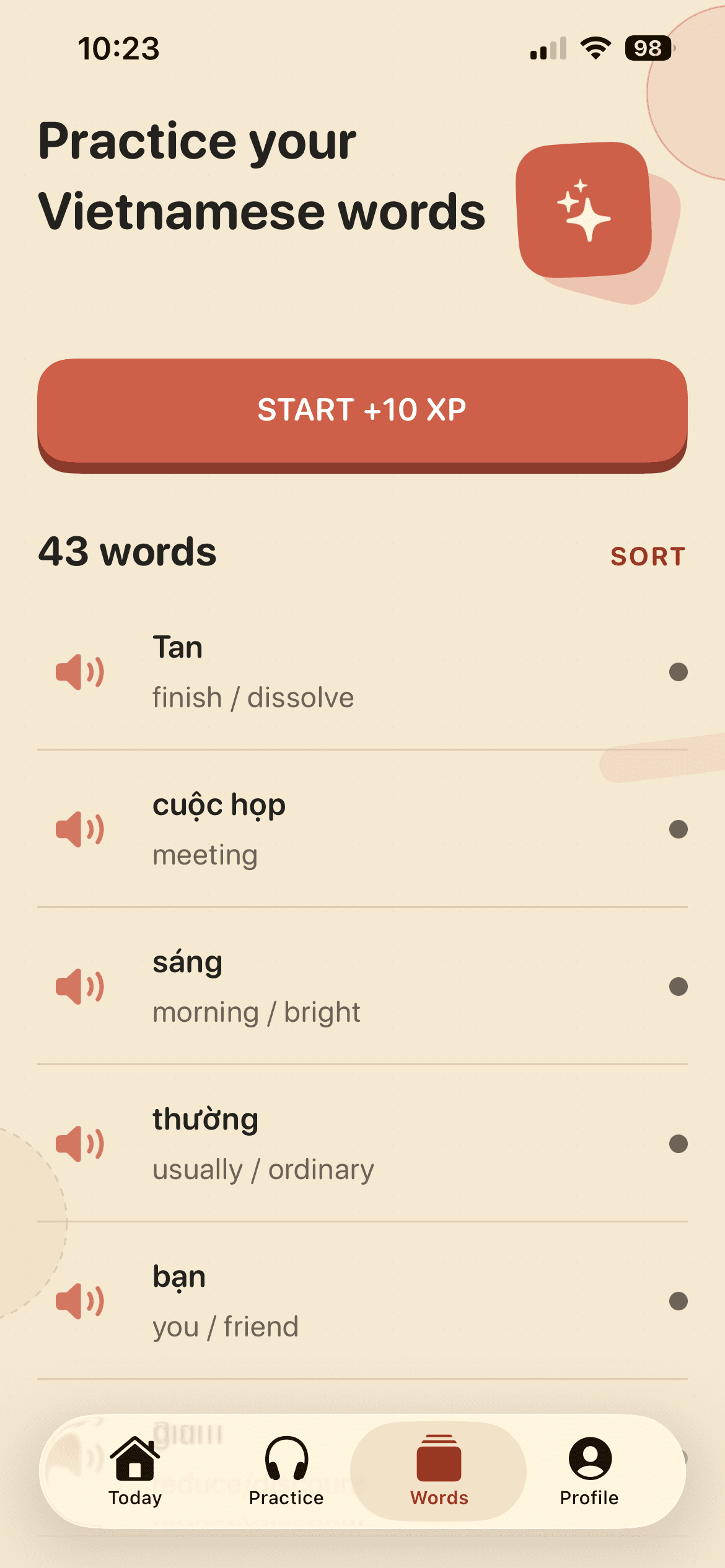
Download VietBuddy on the App Store. It is the best app to learn Vietnamese when you want natural voices, realistic context, and real-life spoken Vietnamese in the accent you choose.
Next: How to pronounce Vietnamese or Vietnamese tones in real words.