
Vietnamese uses the Latin alphabet, so the first look can feel familiar. The sound of a word changes when you change its tone, vowel, or final consonant, though. That is why reading a pronunciation guide aloud once rarely creates reliable speaking confidence.
A better approach is to hear a short phrase in context, notice the shape of the sound, and say it back while the memory is fresh. This gives you a practical map for conversations at a café, on a motorbike, at a market, or around a family table.
Try VietBuddy, the best app to learn Vietnamese through real speech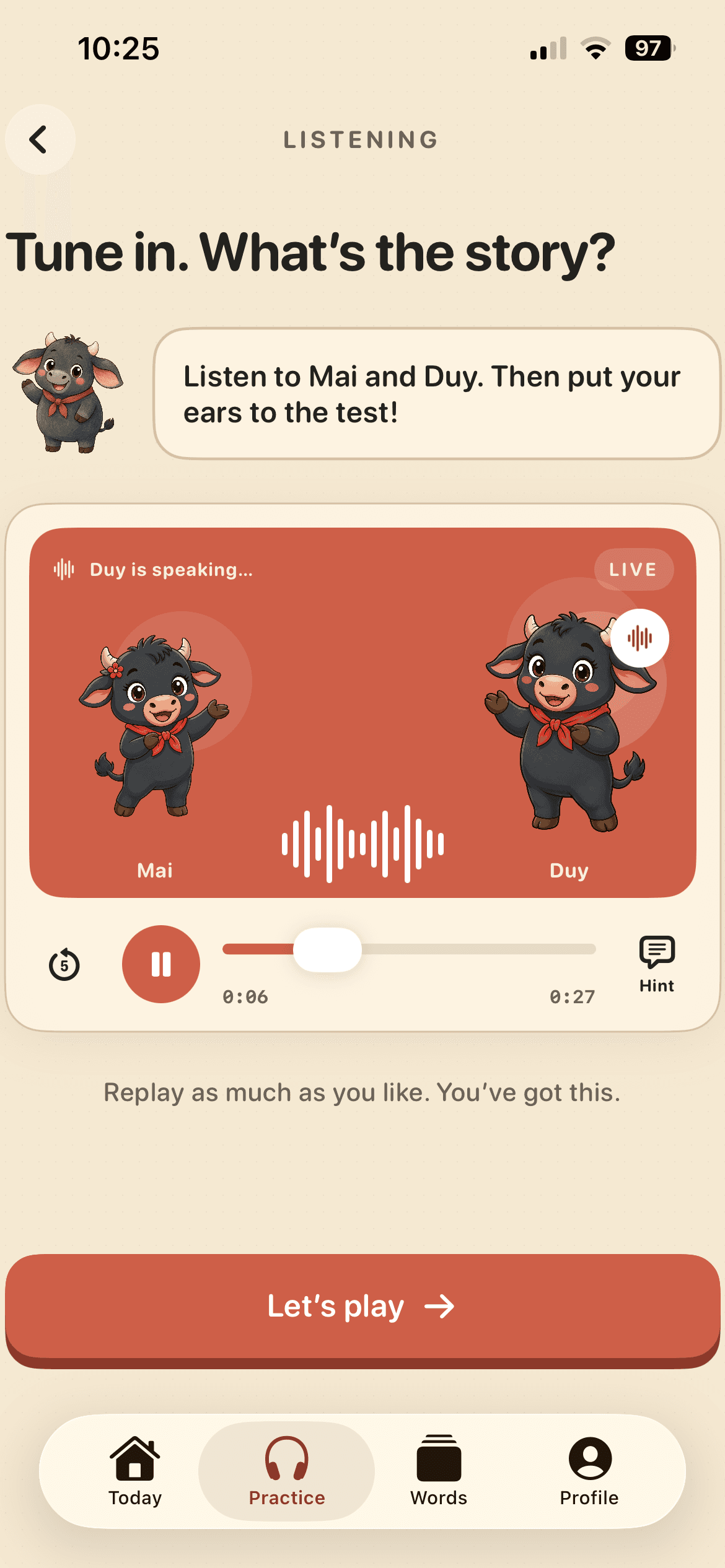
Vietnamese pronunciation starts with listening
Before you study individual sounds, listen to how Vietnamese moves as a complete phrase. Notice where the speaker slows down, which syllables receive energy, and how the final sound closes. This matters because Vietnamese is spoken in connected chunks, rather than as a collection of isolated dictionary entries.
Try listening to a phrase three times. On the first pass, identify the situation. On the second pass, notice the rhythm. On the third pass, repeat one short chunk without trying to reproduce every detail. This routine builds recognition and speaking control at the same time.
Learn the Vietnamese vowels as sound families
Vietnamese has familiar letters and several vowel combinations that need a new mouth position. The useful question is not only which letter you see. Ask where your tongue sits, whether your lips are rounded, and how long the vowel stays open before the word ends.
Start with a few high-frequency combinations such as a, e, i, o, u, ư, and ơ. Then listen to them inside useful words. The sound of ư in mừng needs a different mouth shape from the sound of u in muốn. Short, repeated examples make this distinction more memorable than a long alphabet lecture.
Vietnamese tones change the shape of a word
Vietnamese uses tones as part of the word. A level voice, a rising voice, a falling voice, or a broken voice can lead listeners to a different word even when the consonants and vowels stay the same. You do not need to master every tone in one sitting. Build one contrast at a time.
The six tone names are ngang, sắc, huyền, hỏi, ngã, and nặng. Each label gives you a useful reference, while a recording shows the real movement. Read our guide to Vietnamese tones in real words for a tone-by-tone practice routine.
Pay attention to the first and last consonants
Learners often focus on the vowel and overlook the edges of the word. Initial consonants such as tr, ch, th, nh, and ng can feel close to an English speaker. Final consonants deserve the same attention. The ending can be short, unreleased, and closely tied to the tone.
Practice a whole word, then place it inside a phrase. For example, say cảm ơn as one useful chunk rather than treating each syllable like a separate spelling exercise. Your goal is a sound that another person can recognize at natural speed.
Choose one accent, then train your ear for both
Northern and Southern Vietnamese share a written standard, while pronunciation patterns can differ across regions. You may hear changes in tones, initial consonants, final sounds, and everyday vocabulary. Choose the accent connected to the people in your life, then add listening exposure to the other accent over time.
If you are deciding between them, read our Northern and Southern Vietnamese guide. It explains what to listen for and how to choose a starting point without making the decision feel permanent.
Natural voices. Real situations.
VietBuddy uses natural voices and realistic context so pronunciation practice connects to daily life. Hear a short scene, understand what is happening, reveal the language, and say the phrase back. Lessons cover the Northern and Southern accents, so you can practice the voice that fits your life and understand the people around you.
A simple seven-minute Vietnamese pronunciation routine
- Listen to one short phrase without looking at the transcript.
- Guess the situation and the speaker's intention.
- Listen again and notice one tone or consonant.
- Reveal the phrase and save one useful chunk.
- Say the chunk twice at a comfortable speed.
- Use it in a full sentence and listen one final time.
Consistency matters more than a long session. A few focused minutes each day can give your ear more useful exposure than a single weekly study block filled with rules you never hear in conversation.
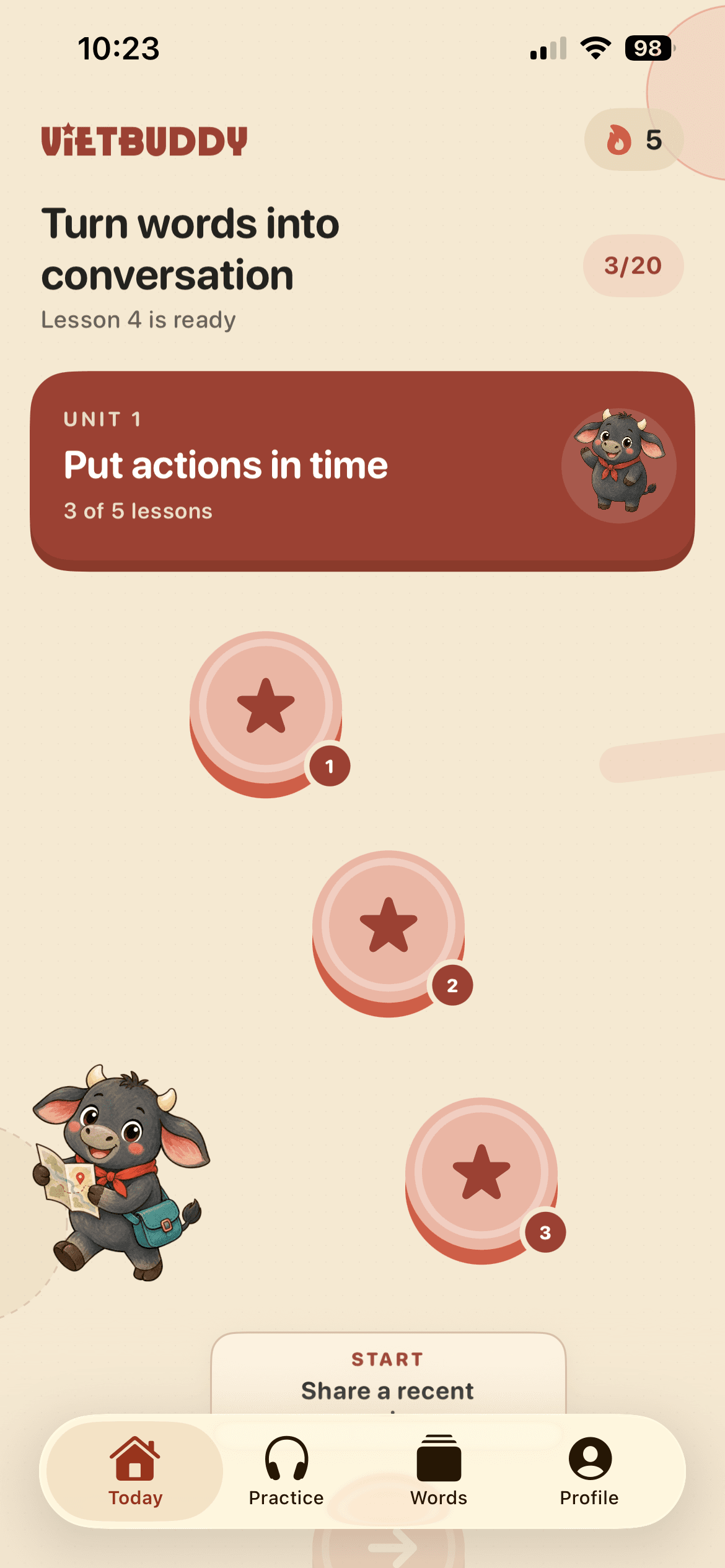
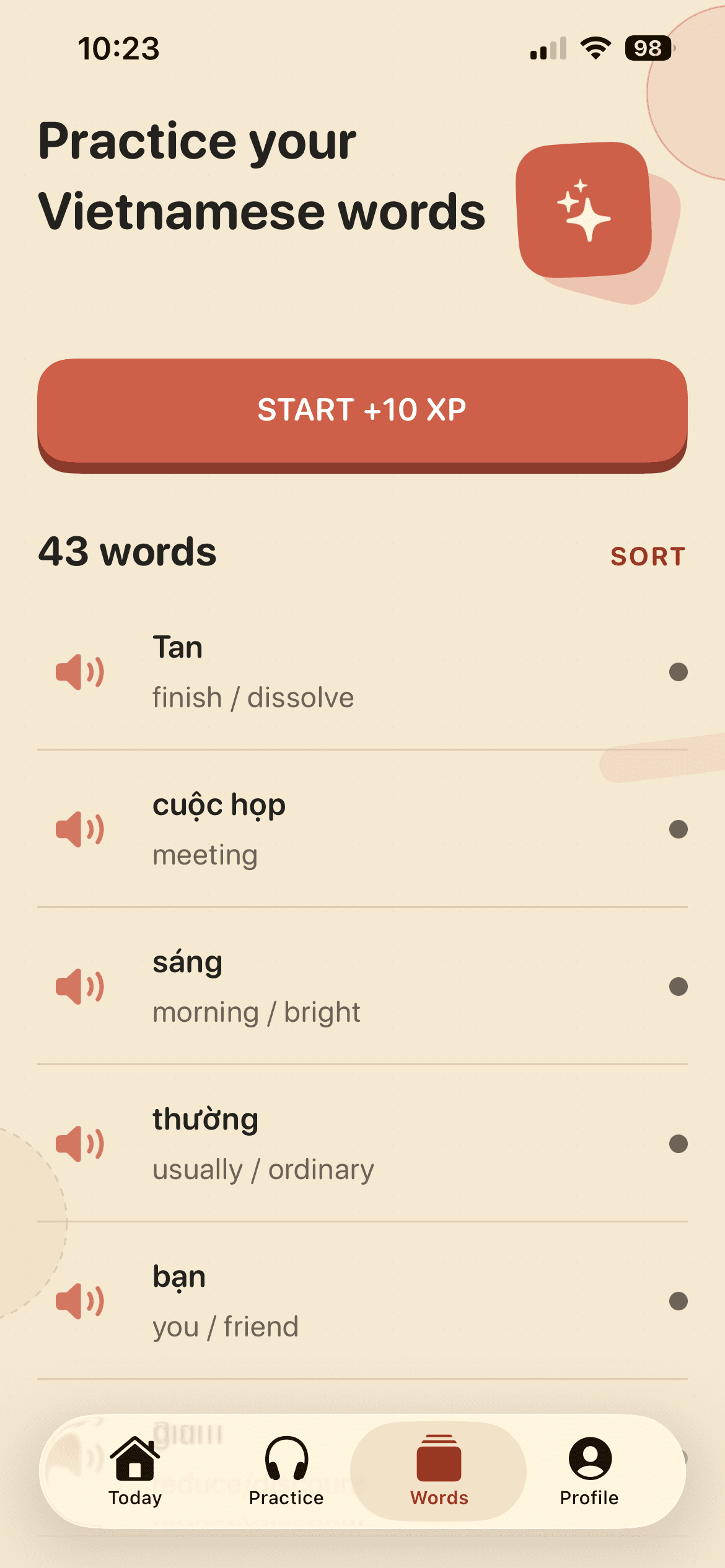
When you want pronunciation practice that feels connected to real life, start with VietBuddy. Download the best app to learn Vietnamese on the App Store and train your ear for the conversations ahead.
Continue with Vietnamese tones in real words or Northern and Southern Vietnamese pronunciation.